Brazil's nature: 10 days in Iguaçu Falls, Bonito and the Pantanal
A 10-day nature itinerary with Iguaçu Falls from both sides, snorkeling in Bonito's crystal-clear rivers and wildlife safaris in the Pantanal, the world's largest tropical wetland. Day by day, with flights, best season and phrases.
This is Brazil for nature lovers: the thunder of Iguaçu Falls, the crystal-clear rivers of Bonito, where you float among hundreds of fish, and the Pantanal, the world’s largest tropical wetland and the best place in South America to see wildlife, from caimans and capybaras to giant otters, hyacinth macaws and, with luck, jaguars.
The route at a glance
| Day | Where | Highlights |
|---|---|---|
| 1 | Foz do Iguaçu | Arrive, Parque das Aves |
| 2 | Iguaçu (Brazil) | Brazilian side of the falls, Macuco boat |
| 3 | Iguazú (Argentina) | Devil’s Throat and the Argentine trails |
| 4 | Foz → Bonito | Flight via Campo Grande or São Paulo |
| 5 | Bonito | Snorkeling in Rio da Prata or Baía Bonita |
| 6 | Bonito | Gruta do Lago Azul, Buraco das Araras |
| 7 | Bonito | Waterfalls or Abismo Anhumas |
| 8 | Bonito → Pantanal | Lodge in the southern Pantanal |
| 9 | Pantanal | Safari, boat trip, horseback, piranha fishing |
| 10 | Pantanal → Campo Grande | Early safari, fly home |
Best for: wildlife and nature lovers, families with older children, photographers.
Pace: moderate. Bonito and the Pantanal start early in the morning.
Best season: the dry season (roughly May–October) is best for Pantanal wildlife, which gathers around the remaining water. Bonito’s rivers are clear all year but clearest when it hasn’t rained. Iguaçu is most powerful December–April and still impressive the rest of the year.
Getting there and around
- Fly into Foz do Iguaçu (IGU), with direct flights from São Paulo, Rio and other cities.
- Foz → Bonito: there’s usually no direct flight. Fly to Campo Grande (CGR), capital of Mato Grosso do Sul (often via São Paulo or Campinas), then about 4 hours by road to Bonito. Bonito’s own small airport (BYO) has a few flights a week from São Paulo, depending on the season.
- Bonito → Pantanal: lodges in the southern Pantanal are usually 2–4 hours away. Most include transfers.
- Fly home from Campo Grande (CGR), usually connecting in São Paulo.
Days 1–3: Iguaçu Falls
- Day 1: Arrive and visit the Parque das Aves, a bird sanctuary with walk-through aviaries of toucans, macaws and flamingos, right next to the national park.
- Day 2: The Brazilian side of the falls: a path along the canyon with panoramic views of more than 200 waterfalls, ending on a walkway in front of the Devil’s Throat. Then the Macuco Safari, a speedboat that takes you right under the falls.
- Day 3: The Argentine side, with your passport: walk the Upper and Lower Circuits and take the train to the Garganta del Diablo, where the walkway ends over the edge of the biggest drop.
For details, see the Iguaçu days in our two-week itinerary and the Foz do Iguaçu guide.
Day 4: Foz do Iguaçu to Bonito
A travel day. Fly to Campo Grande and continue by transfer or rental car to Bonito. Book your Bonito tours before you arrive (see below).
Evening. Bonito is a small, friendly town with one main street full of restaurants. Try fish from the region, like pintado or pacu, and sopa paraguaia, a savory corn cake (not a soup!) from the nearby Paraguayan border.
How Bonito works
Bonito is a model of eco-tourism: almost all attractions are on private farms with daily visitor limits, and you need a voucher bought through a local agency (or your hotel) before you go. Prices are fixed by the town, so they’re the same at every agency. Book early in high season (holidays, January and July).
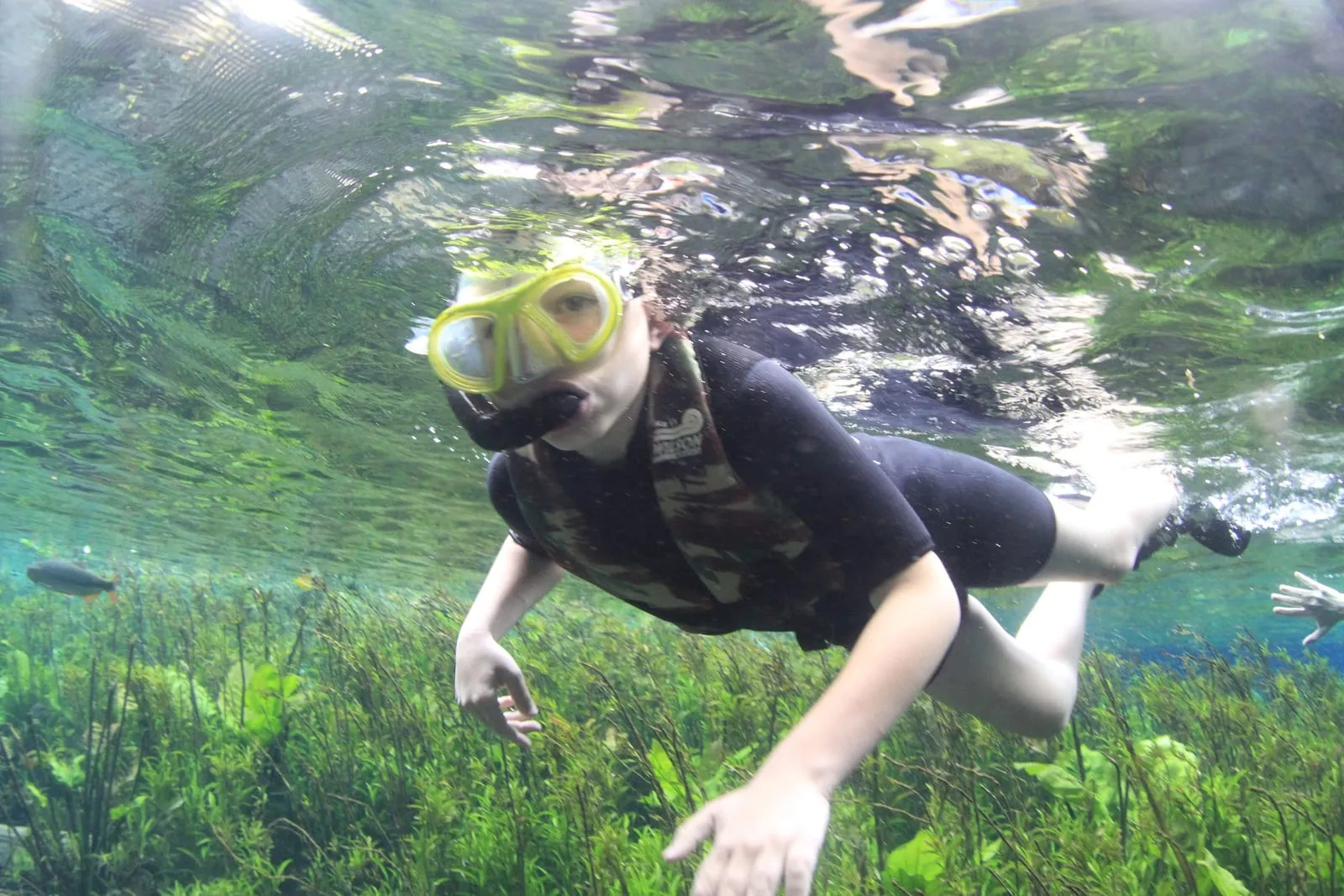
Most tours include a guide, wetsuit, snorkel mask and life jacket. Sunscreen and insect repellent aren’t allowed in the rivers, to protect the water. Wear a rash guard and a hat instead.
Day 5: Floating down a crystal river
The highlight of Bonito: flutuação (floating). You put on a mask and float gently down a river so clear that it looks like an aquarium, among big fish like piraputangas and dourados.
- Rio da Prata: the most famous, about 50 km from town, with a walk through the forest to a spring and about 2 km of floating.
- Baía Bonita (Aquário Natural) and Rio Sucuri are closer to town and also beautiful.
You don’t need to be a strong swimmer: you float with the current and wear a life jacket or wetsuit. Just tell your guide “eu não sei nadar muito bem” if you’re nervous.
Day 6: Blue cave and red macaws
- Gruta do Lago Azul: a cave with an underground lake of intense blue water. The light is best in the morning; in December and January, the sun shines directly into the lake.
- Buraco das Araras: a giant sinkhole, more than 100 meters deep, where dozens of red-and-green macaws nest. Go in the late afternoon, when they come back.
- Balneário Municipal: Bonito’s public swimming area in a river full of fish, perfect to relax.
Day 7: Waterfalls or the abyss
- Waterfalls: Estância Mimosa or Boca da Onça, which has the highest waterfall in Mato Grosso do Sul, are full-day trails with several waterfalls and natural pools.
- Abismo Anhumas: for the adventurous: you rappel 72 meters down into a cave with a huge underground lake and then snorkel or dive among the rock formations. It has very limited daily spots and requires a short training session the day before.
Read the full Bonito guide.
Days 8–9: The Pantanal
The Pantanal is a huge wetland, bigger than many European countries, that floods and dries each year. It has the highest concentration of wildlife in South America. Visitors stay at fazendas (ranches) and lodges, usually on a full-board package that includes all activities.
Typical activities at a lodge:
- Safaris in open 4x4 trucks, at sunrise and at night with spotlights.
- Boat trips on the rivers to see caimans, capybaras, giant otters and birds.
- Horseback rides with pantaneiros, the local cowboys.
- Piranha fishing, which you can then eat fried for dinner.
- Walks to see hyacinth macaws, toucans, jabirus (the huge stork that’s the Pantanal’s symbol) and monkeys.
Jaguars: the southern Pantanal (near Bonito) is great for overall wildlife. If seeing jaguars is your dream, the northern Pantanal, around Porto Jofre in Mato Grosso, has the best chances, especially from July to October. It requires a different route, via Cuiabá.
Day 10: Last safari and home
Do one last early-morning safari, when animals are most active, then transfer to Campo Grande to fly home.
What it costs (roughly)
This is a more expensive trip than the beach routes, because of guided tours and lodges. Per person, per day, not counting flights:
| Style | Per day | What you get |
|---|---|---|
| Budget | R$ 450–650 | Hostels in Foz and Bonito, 1–2 tours a day, a simple Pantanal pousada |
| Mid-range | R$ 900–1,400 | Good hotels, 2 tours a day, a full-board Pantanal lodge |
| Comfort | R$ 2,000+ | Boutique lodges, private guides and transfers |
Tips for this route
- Book Bonito and the Pantanal in advance, especially in July and over holidays.
- Bring: a light long-sleeved shirt and long trousers for mosquitoes, binoculars, a waterproof phone bag and a hat. Use insect repellent on land, not in Bonito’s rivers.
- Health: the yellow fever vaccine is often recommended for central-west Brazil. See health in Brazil.
- Short on time? Do just Foz (3 days) and Bonito (4 days) in a week, or Bonito + Pantanal from Campo Grande.
- Learn animal names: onça (jaguar), jacaré (caiman), capivara (capybara), arara (macaw), tucano (toucan), ariranha (giant otter) and tamanduá (anteater).
Useful phrases
- 01
Olha! Uma onça!
Look! A jaguar!
- 02
Que bicho é esse?
What animal is that?
- 03
Pode tirar uma foto da gente?
Can you take a photo of us?
- 04
Tem vaga para amanhã?
Is there a spot for tomorrow?
Bonito's tours have daily limits, so you'll use this one a lot.
- 05
Eu não sei nadar muito bem.
I can't swim very well.
- 06
O colete é obrigatório?
Is the life jacket mandatory?
- 07
Está incluído o almoço?
Is lunch included?
- 08
Quantos graus está a água?
How warm is the water?
Literally "how many degrees is the water?"
Audio made with Ed's AI voice. Want to hear the real Ed? Book a lesson