Oysters
Florianópolis produces most of Brazil's oysters. Order them fresh with lemon, steamed or gratinated with cheese.
"Uma dúzia de ostras frescas."A dozen fresh oysters.
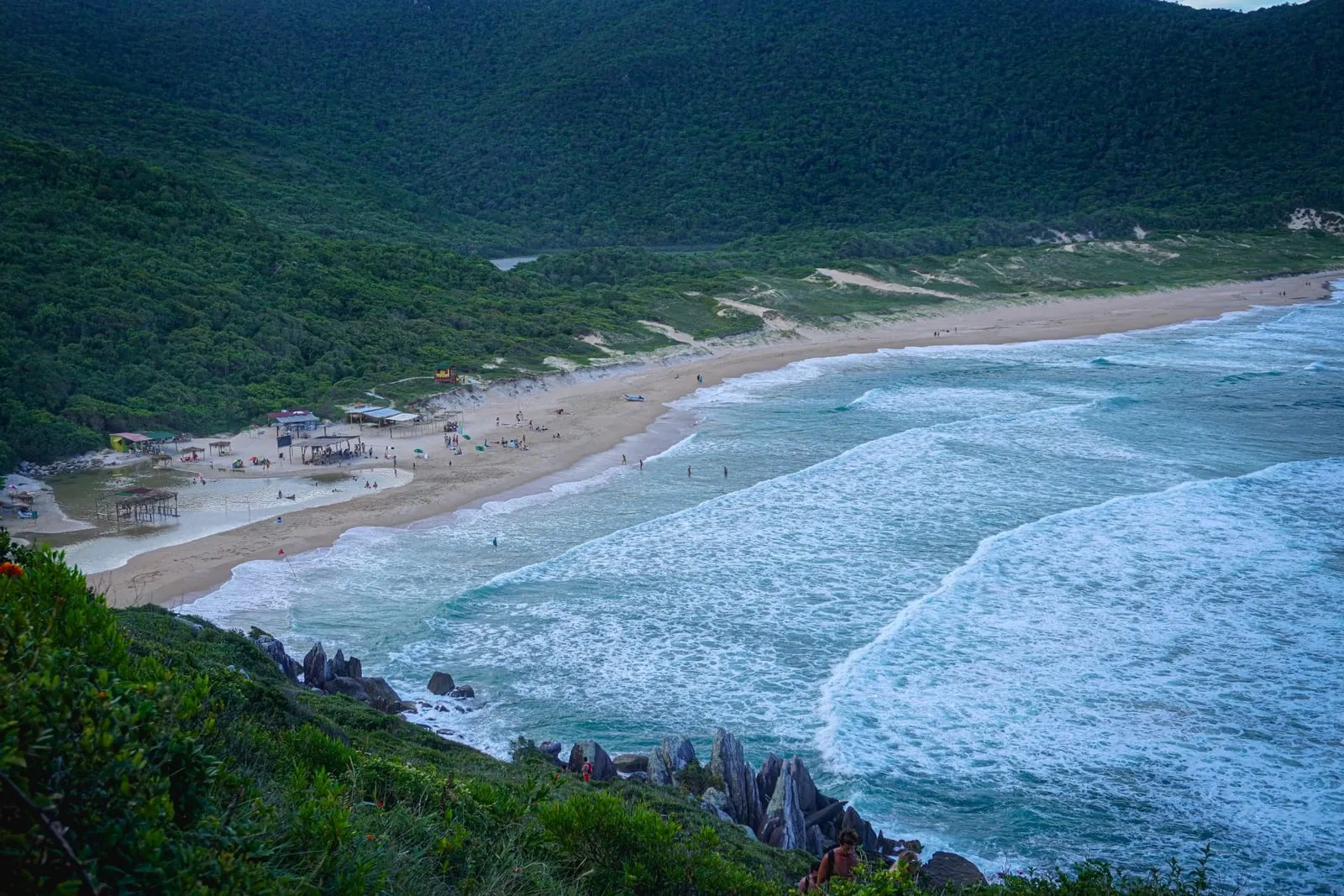
An island of beaches, lagoons, trails and fresh oysters, plus the Portuguese you'll need from the bus stop to the surf shop.
Florianópolis, or just Floripa, is a city spread over a green island in southern Brazil. It’s famous for having dozens of beaches, from calm bays to surf spots, plus lagoons, dunes, forest trails and some of the best seafood in the country.
The island has a special identity. Many locals descend from settlers from the Azores, and native islanders are affectionately called manezinhos. Their accent is fast and musical, and they often use “tu” instead of “você”. It’s a fun place to train your ear, and people are relaxed and helpful with visitors who try to speak Portuguese.
A practical tip: the island is bigger than it looks, and traffic in summer can be heavy. Plan your days by region (north, east, south) and leave early for the beaches.
Updated November 2026 · by Ed
The Portuguese you'll actually use here. Tap to hear how it sounds, then say it out loud.
Start every question with "Com licença…" (excuse me) and end with "obrigado" (if you're a man) or "obrigada" (if you're a woman).
Qual ônibus vai para a Lagoa da Conceição?
Which bus goes to Lagoa da Conceição?
Dá pra fazer essa trilha sozinho?
Can I do this trail on my own?
"Dá pra…?" is the everyday way to ask "is it possible to…?"
Quero alugar uma prancha.
I want to rent a surfboard.
A água está fria?
Is the water cold?
Tem ostra fresca?
Do you have fresh oysters?
Florianópolis is Brazil's oyster capital. Try them raw, steamed or gratinated.
Onde tem um bom lugar para ver o pôr do sol?
Where's a good place to watch the sunset?
Quanto tempo leva até a praia?
How long does it take to get to the beach?
Tu é daqui?
Are you from here?
Locals ("manezinhos") often use "tu" instead of "você", a legacy of the island's Azorean settlers.
Audio made with Ed's AI voice. Want to hear the real Ed? Book a lesson
The island is big. Plan one area per day: the Lagoa and east coast, the north, the south and downtown. With 4–5 days you'll see the best of it.
Beaches are spread out and buses are slow, with transfers at terminals. A rental car (or ride-hailing apps) makes it much easier.
Airbnb is very popular here, from apartments to beach houses. In summer (December to February), book early, because prices go up a lot.
With a useful phrase for each one.

The island's lively center sits on a big lagoon surrounded by hills and dunes. It's full of restaurants, bars and water sports, and it's a great base to explore. Nearby, the Joaquina dunes are famous for sandboarding.
"Onde eu alugo uma prancha de sandboard?"
Where can I rent a sandboard?

Joaquina, Praia Mole and Campeche face the open ocean, with good waves and long stretches of sand. Even if you don't surf, they're beautiful for walking and watching the surfers.
"Tem aula de surfe para iniciantes?"
Are there surf lessons for beginners?

This small fishing village on the bay side keeps its Azorean colonial houses and is one of the best places to eat fresh oysters while the sun sets over the water. Ribeirão da Ilha, in the south, is another classic.
"Uma dúzia de ostras gratinadas, por favor."
A dozen gratinated oysters, please.

One of the most beautiful beaches on the island can only be reached on foot. The trail through the Atlantic Forest takes around an hour or more each way, and the reward is a wild beach with a small lagoon behind it.
"A trilha é difícil?"
Is the trail difficult?

In the city center, visit the historic Mercado Público for food and drinks, and walk to see the Hercílio Luz Bridge, the island's postcard, especially when it lights up at night.
"Onde fica o Mercado Público?"
Where is the Public Market?

A protected island just off the south-east coast with dazzling Caribbean-turquoise water, soft white sand and guided trails to ancient indigenous rock engravings. Daily visitor limits apply — book ahead in summer.
"Que horas sai o barco para a Ilha do Campeche?"
What time does the boat to Ilha do Campeche leave?

Hop on a public wooden boat across Lagoa da Conceição to a car-free fishing village accessible only by water or trail — hike 10 minutes to a forest waterfall, then eat fresh seafood right on the dock.
"Em qual ponto desce para a cachoeira da Costa da Lagoa?"
Which boat stop do we get off at for the Costa da Lagoa waterfall?

The north side offers warm, calm bay waters and chic beach clubs in Jurerê Internacional, plus clear ocean surf and scenic hill views at neighboring Praia Brava.
"O mar em Jurerê é bem calminho?"
Is the sea in Jurerê very calm?

Explore the island's oldest Azorean neighborhood in the south — colorful colonial facades, calm bay sunsets and renowned oyster farms — and drive up Morro da Cruz for a 360-degree view of the city and bridges.
"Qual restaurante em Ribeirão da Ilha tem deck sobre o mar?"
Which restaurant in Ribeirão da Ilha has a deck over the water?
The local dishes worth trying, and how to order them.
Florianópolis produces most of Brazil's oysters. Order them fresh with lemon, steamed or gratinated with cheese.
"Uma dúzia de ostras frescas."A dozen fresh oysters.

An island classic: a feast of shrimp served in several ways, fried, breaded, in a stew and with rice, one plate after another.
"Quanto custa a sequência de camarão?"How much is the shrimp feast?

Mullet is the island's traditional fish, caught by local fishermen in autumn and early winter. Try it grilled or stuffed.
"Tem tainha hoje?"Do you have mullet today?

Traditional manezinho comfort food — tender local cockles stewed with garlic and tomatoes (pastel de berbigão is a Mercado Público favorite) and gratinated stuffed crab shells.
"Vocês têm pastel de berbigão quentinho?"Do you have warm berbigão pastel?

Rich, velvety fish-broth cassava purée served alongside every island seafood platter, often finished with a local artisanal cachaça from Santo Antônio or Ribeirão da Ilha.
"Esse peixe acompanha pirão?"Does this fish come with pirão?

Tip: in Brazil a pousada is a small guesthouse, often family-run, with breakfast included.
Landing at the airport? Book a private airport transfer with an English-speaking driver waiting for you.
Stay connected from the moment you land: Get a Brazil eSIM (data plan you install before the trip). How it works
Affiliate links: Ed may earn a small commission at no extra cost to you.

A clear guide to where to stay in Florianópolis (Floripa) — Lagoa da Conceição, Campeche, Jurerê, Barra da Lagoa and Santo Antônio de Lisboa — with hotel links and Portuguese phrases.
Read guide
Everything you need for a smooth arrival in Brazil — private airport transfers in Rio, São Paulo, Salvador and Floripa, booking domestic flights, travel eSIMs and useful Portuguese phrases.
Read guide
How Brazilians celebrate New Year's Eve (Réveillon): Copacabana fireworks, wearing white, jumping seven waves, top beach towns to ring in the new year, booking tips and Portuguese phrases.
Read guide
Planning a trip to Southern Brazil? Discover Oktoberfest in Blumenau (October) and Natal Luz in Gramado (November–January) — how to visit, where to stay, booking links and Portuguese phrases.
Read guideA 10-day Southern Brazil itinerary combining Curitiba's parks and train ride, Florianópolis beaches, Gramado's mountains and wine country, and Iguaçu Falls — with hotels, flights and Portuguese phrases.
Read guideFly into FLN. Florianópolis airport (FLN) is about 1 h by plane from São Paulo and has flights from Buenos Aires and other South American cities. The island connects to the mainland by bridge.
Dec–Mar · Sep–Nov. December to March is beach season (hot, lively and busy). September to November is milder and quieter. Winter (June to August) gets cool.
Around R$ 350–650 / day. Rough mid-range estimate per person (pousada, meals, local transport). Summer and holidays are much more expensive.
4–5 days. The island is big. Plan one area per day: the Lagoa and east coast, the north, the south and downtown. With 4–5 days you'll see the best of it.
Recommended. Beaches are spread out and buses are slow, with transfers at terminals. A rental car (or ride-hailing apps) makes it much easier.
Lagoa da Conceição: Central and lively, with restaurants and nightlife, and quick access to the east coast beaches. Campeche & the south: Calmer, with beautiful beaches and close to the airport. Great for nature and trails. Jurerê & the north: Calm, warm water and family-friendly beaches. Jurerê Internacional is the upscale area. Centro: Practical and cheaper, near the market and the bridge, but far from the best beaches.
Airbnb is very popular here, from apartments to beach houses. In summer (December to February), book early, because prices go up a lot.
Some people in hotels and tourist businesses speak English, but most locals speak only Portuguese. Learning a few phrases, like the ones in this guide, makes your trip much easier and Brazilians really appreciate the effort.
Everything on this site is free, and it'll stay that way. If you'd like extra help, here's what Ed offers:

A surf village where you cross a river to reach the beach, surrounded by green hills and a state park, near Florianópolis, plus the Portuguese you'll need there.

A green bay with surf, lagoons and right whales swimming close to the sand in winter, plus the Portuguese you'll need there.

Clear-water beaches, diving in a marine reserve and coastal trails in southern Brazil, plus the Portuguese you'll need there.

20 essential phrases and a simple 7-day plan to start speaking real Brazilian Portuguese.