Rota das Emoções: 8 days from Jericoacoara to Lençóis Maranhenses
An 8-day itinerary along Brazil's "Route of Emotions", from the dunes and lagoons of Jericoacoara through the Parnaíba Delta to the white sand dunes and blue lagoons of Lençóis Maranhenses. Day by day, with transport, best season and phrases.
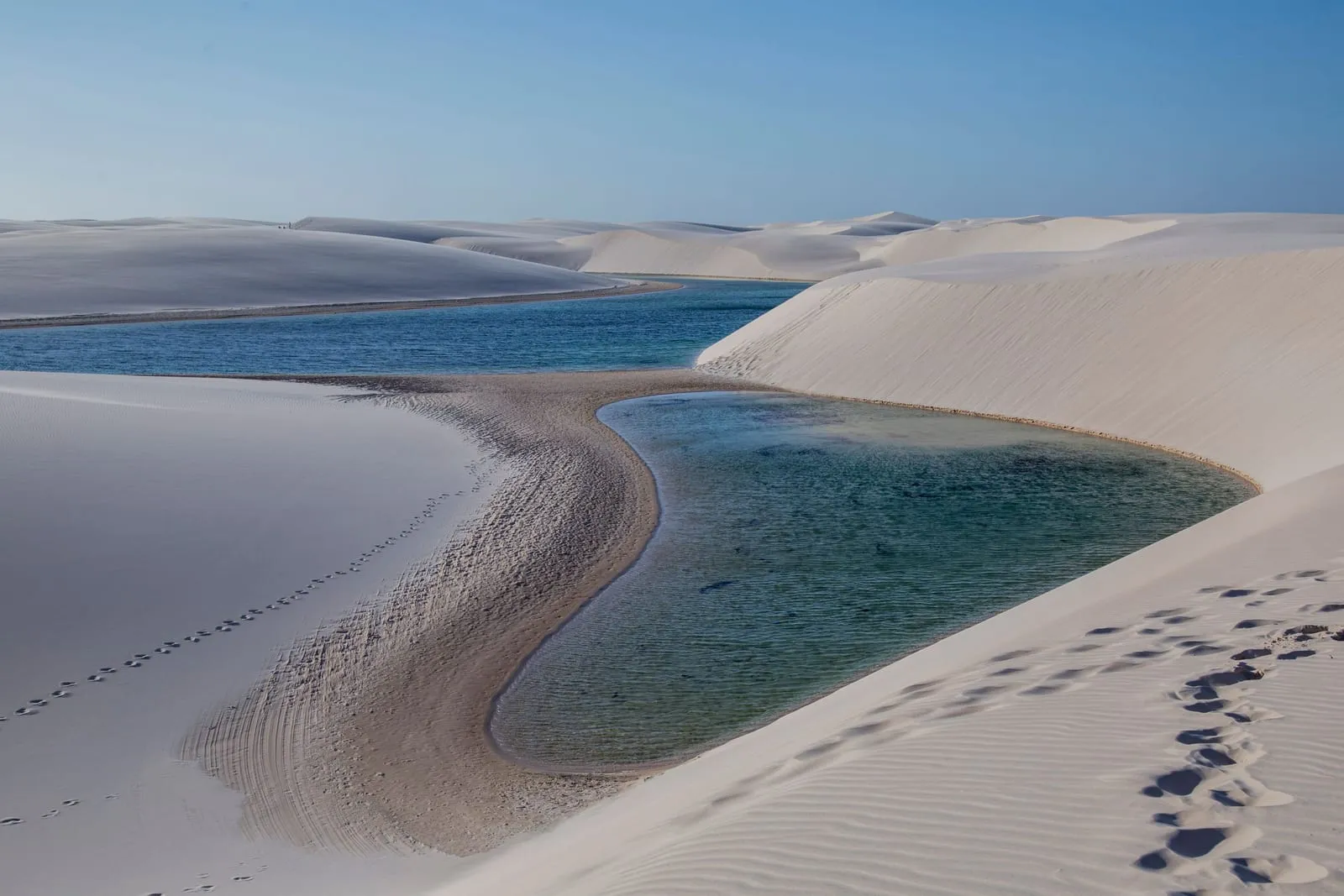
The Rota das Emoções (“Route of Emotions”) links three states of Brazil’s northeast coast: Ceará, Piauí and Maranhão. In about a week, you go from the kitesurfing village of Jericoacoara, through the mangroves and islands of the Parnaíba Delta, to the surreal white dunes and rainwater lagoons of Lençóis Maranhenses. Much of it is traveled by 4x4 along the beach. It’s one of the most spectacular trips in Brazil.
The route at a glance
| Day | Where | Highlights |
|---|---|---|
| 1 | Fortaleza → Jericoacoara | Transfer to Jeri, sunset on the big dune |
| 2 | Jericoacoara | Pedra Furada, Lagoa do Paraíso, hammocks in the water |
| 3 | Jericoacoara | Buggy tour west or a kitesurf lesson |
| 4 | Jeri → Parnaíba Delta | 4x4 along the coast, delta boat trip |
| 5 | Delta → Atins or Barreirinhas | Mangroves, then on to Maranhão |
| 6 | Lençóis Maranhenses | Lagoons and dunes, sunset in the park |
| 7 | Lençóis Maranhenses | Rio Preguiças boat trip, Mandacaru lighthouse |
| 8 | Barreirinhas → São Luís | Transfer to São Luís, fly home |
Best for: beach and nature lovers, photographers, adventurous travelers.
Pace: moderate, with several long (but scenic) transfer days.
When to go: timing is everything
The lagoons of Lençóis Maranhenses are filled by rain. They are usually fullest from June to September, with July and August often the best months. From about October, they start to dry up, and by December many are empty. The rainy season itself (roughly January to May) can make the trails and dirt roads difficult.
Jericoacoara is lovely all year, and July to December is peak wind season for kitesurfing. So the sweet spot for the whole route is July to September.
Getting there and around
- Fly into Fortaleza (FOR) and out of São Luís (SLZ), or the reverse. Open-jaw tickets save you a long trip back.
- Fortaleza → Jericoacoara: about 4–6 hours by shared or private transfer. The last part is on sand, so cars switch to 4x4 trucks or buggies. Jericoacoara airport (JJD), near Cruz, has some direct flights from São Paulo and is about 30–45 minutes from the village.
- Between towns: the easiest way is to book the whole route with a local agency, including 4x4 transfers. Doing it on your own by bus is possible, but slower.
- Barreirinhas → São Luís: about 4 hours by road.
Fees: Jericoacoara charges visitors a small daily environmental fee (TTA), paid online or on arrival. Keep the receipt.
Day 1: Fortaleza to Jericoacoara
Land in Fortaleza and take a transfer to Jeri. If you arrive late, spend the night in Fortaleza and travel the next morning: the beachfront in Praia de Iracema and Meireles is pleasant for an evening walk.
Sunset. Jericoacoara’s big ritual: everyone walks up the Duna do Pôr do Sol (Sunset Dune) to watch the sun go down over the sea. Afterward, there’s often a capoeira circle on the beach.
Evening. Jeri’s sandy streets have no streetlights and no asphalt, but there are excellent restaurants, forró dancing and caipirinha stands on the beach.
Day 2: Pedra Furada and Lagoa do Paraíso
Morning. Walk along the beach (about 30–40 minutes at low tide) to Pedra Furada, a natural rock arch and Jeri’s symbol. Check the tide table: you can only get close at low tide. Around the June and July solstice, the sun sets right through the arch.
Afternoon. Take a buggy or 4x4 to the Lagoa do Paraíso and Lagoa Azul, freshwater lagoons with turquoise water and hammocks hung in the water. Order lunch and drinks without leaving your hammock. On the way, see the Árvore da Preguiça (Lazy Tree), bent sideways by the wind.
Day 3: Buggy tour or kitesurf
- Buggy tour west: dunes, the Mangue Seco mangroves with seahorses, the Tatajuba lagoon and the village of the same name. The driver will ask you “com emoção ou sem emoção?”.
- Kitesurf or windsurf: Jeri and the nearby Preá beach are among the best spots in the world. Book a beginner’s lesson.
- Do nothing: honestly, Jeri is also great for that.
Read the full Jericoacoara guide.
Day 4: Along the coast to the Parnaíba Delta
Today you travel west by 4x4 along beaches, dunes and small fishing villages, sometimes crossing rivers on tiny ferries. Many routes stop at Camocim and arrive in Parnaíba (Piauí) in the afternoon.
The Delta do Parnaíba is one of the only open-sea deltas in the Americas, with more than 70 islands. In the afternoon, take a boat trip through the mangroves and watch thousands of red ibis (guará) fly back to their nests at sunset, and the crab catchers at work.
Read the full Delta do Parnaíba guide.
Day 5: On to Maranhão
Continue by 4x4 or van to Atins or Barreirinhas, the gateways to Lençóis Maranhenses National Park.
- Atins: a small, sandy village at the mouth of the Preguiças River, next to the dunes. Quiet, beautiful and popular with kitesurfers.
- Barreirinhas: a town on the river, bigger and with more hotels, restaurants and tour options. Easier to reach from São Luís.
Many travelers spend one night in each.
Day 6: The lagoons of Lençóis Maranhenses
The park is a desert of white dunes stretching up to 50 km inland, with thousands of blue and green rainwater lagoons between them in the right season. Tours go into the park by 4x4, and then you walk barefoot over the dunes.
- Lagoa Azul and Lagoa Bonita circuits from Barreirinhas: each takes about half a day. Lagoa Bonita has a steep dune climb with a rope at the start.
- From Atins, you can walk or take a 4x4 straight into the dunes and lagoons on the park’s eastern side, and have lunch at Canto de Atins, a remote spot famous for its grilled shrimp.
Go in the afternoon to see the sunset over the dunes. Bring water, a hat, sunglasses and sunscreen: there is no shade.
Day 7: Rio Preguiças and the lighthouse
Take a boat down the Rio Preguiças to its mouth: stop at Vassouras (small dunes with friendly monkeys), Mandacaru (climb the lighthouse for a view of the coast) and Caburé, a sandbar between the river and the sea, for lunch.
Read the full Lençóis Maranhenses guide.
Day 8: São Luís and home
Drive about 4 hours to São Luís, capital of Maranhão. If you have a few hours before your flight, walk around the historic center, a UNESCO World Heritage site with hundreds of colonial buildings covered in Portuguese azulejos (tiles). São Luís is also known as Brazil’s reggae capital.
What it costs (roughly)
Per person, per day, not counting flights:
| Style | Per day | What you get |
|---|---|---|
| Budget | R$ 300–450 | Hostels and simple pousadas, shared transfers and tours |
| Mid-range | R$ 700–1,100 | Good pousadas, a packaged route with an agency |
| Comfort | R$ 1,600+ | Boutique hotels, private 4x4 with driver |
The 4x4 transfers are the biggest cost. Traveling as a group of 3 or 4 makes private transfers much cheaper per person.
Tips for this route
- Check the lagoon season before booking. An empty lagoon in December is a big disappointment.
- Travel light: you’ll be in the back of 4x4 trucks and buggies. A soft bag or backpack is much easier than a hard suitcase.
- Cash: bring some, as small villages and beach stalls may not take foreign cards.
- Forró: this is the land of forró, the partner dance of the Northeast. Don’t be shy if someone asks “Vamos dançar?”.
- Northeastern Portuguese: listen for “Oxe!”, “Arretado!” (awesome) and “Visse?” (you see?) at the end of sentences.
Useful phrases
- 01
Quanto custa o passeio de buggy?
How much is the buggy tour?
- 02
Com emoção ou sem emoção?
With emotion or without?
Buggy drivers ask this. "Com emoção" means a wild ride up and down the dunes!
- 03
As lagoas estão cheias?
Are the lagoons full?
- 04
A que horas a gente sai?
What time do we leave?
"A gente" is the everyday spoken way to say "we" (instead of "nós").
- 05
Dá pra nadar aqui?
Can we swim here?
"Dá pra" is the spoken form of "dá para": "is it possible to".
- 06
Uma rede na sombra, por favor.
A hammock in the shade, please.
- 07
Que vento!
What wind!
- 08
Vamos ver o pôr do sol na duna?
Shall we watch the sunset on the dune?
Audio made with Ed's AI voice. Want to hear the real Ed? Book a lesson